DOTOK DOTOK DOTOK…

engine driver with teapot

PICKINGS from my NORTH KOREAN DIARY 11.–21.

Girls dig in the trenches - heads on the rim

April 2011

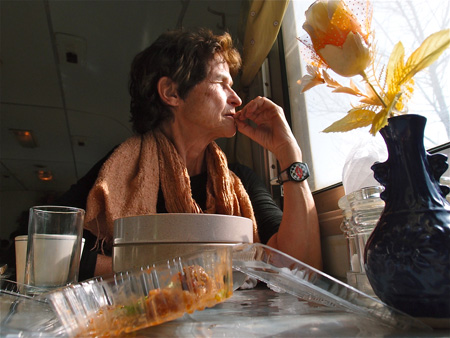
Dining car - What is flashing through her mind?

THE TRAIN  is moving at a leisurely pace through the hills and fields, crossing large riverbeds, some carry only a trickle of water.

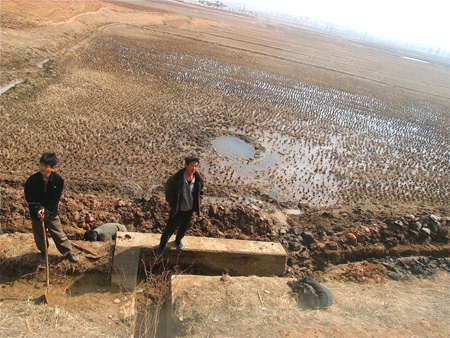
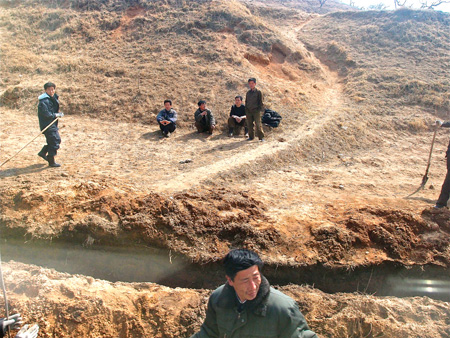
...passing by - men with shovels...

Repairing the trenches

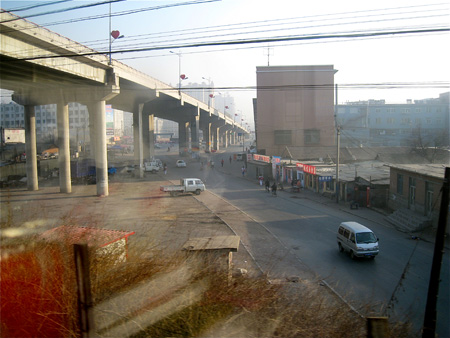
View from my sleeper bed

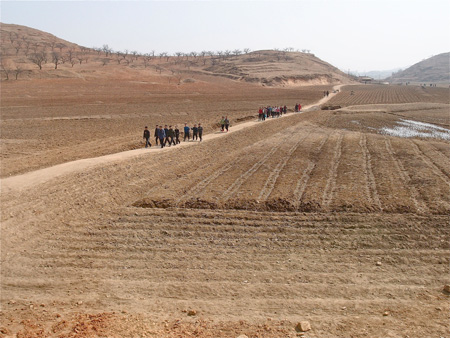
Workers head to the field

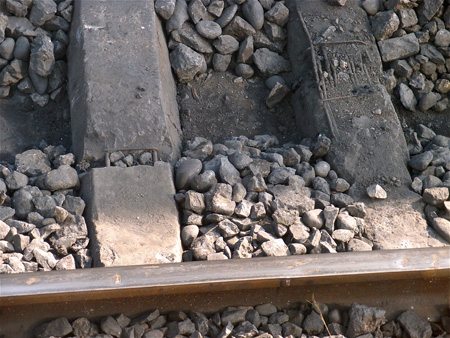
The railway track-sills need repair, some are broken.

We travel at 30-50km/h

We head to the restaurant wagon over luggage and people in the gangway.

Goods for Pyongyang

...sleeping...

Passengers are playing, eating, talking, sleeping.

Dining car – we are in good company

The supper we had ordered is ready and we mix with the Chinese who bring their goods to Pyongyang. It takes us 26 hours to travel from Beijing to Pyongyang at a speed of 30-50km. The heart and mind has time to adjust – from China to North Korea we travel back in time. Sometimes it looks like the Middle Ages but more often the horrible Stalin area comes to my mind.

a KAFKAESQUE LAND with aspects of BRUEGHEL and a BUCOLIC touch, DPRK

prime PICKINGS from my NORTH KOREAN DIARY 11.–21. April 2011

Tool of the land

A bucolic touch...

As THE TRAIN pulled out of the Korean border station two hours late – the customs inspection had taken over four hours all in all – it suddenly became clear to me that we were on our way to a KAFKAESQUE land with aspects of BRUEGHEL and a BUCOLIC touch.

...as far as the eye could see...

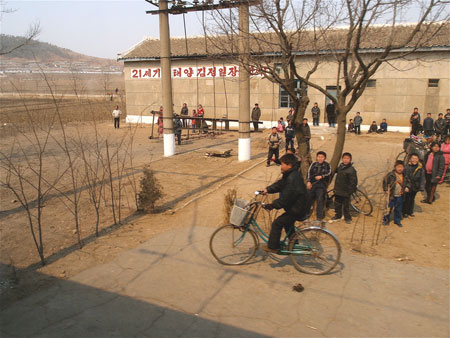
As far as the eye could see: groups of farm workers, schoolchildren moving by foot to the fields, a few on bicycles, detachments of soldiers with shovels, some on military trucks, farm workers with ox carts, men ploughing the field.

men – women – soldiers – children

Men and women of all ages hacking and working in the water channels and the rice fields with almost no mechanized help beside an old tractor here and there, cows pulling the plows, the rest all handwork. Cooperatives and villages dotted the land.

A Cooperative Farm in the background

Farm workers

But the BRUEGHEL and BUCOLIC touch soon gave way to the harsh reality of a hermetically sealed of population with no exit out of the cooperatives, the villages, the cities, the country without official permission. If the desperate and the hungry flee over the border to China, Big Brother shows no pity. He sends them back to North Korea where they end up in labor camps or are shot dead as it had happened during the horrible flooding catastrophe in 1974 when 3 million people died and starvation followed.

NORTH KOREAN CUSTOMS at DONGAN

End of China - we cross over the river to DPRK - attraction point for the Chinese

iPHONE PICKINGS from my NORTH KOREAN DIARY 11.-21. April 2011

FOUR AND A HALF HOURS it took us to pass customs control from China to North Korea.

DPRK customs official comes to railcar Nr.12

It was not a pain in the neck, not at all, it just took time.

As we entered Dongan border station, there was a load of Chinese business men flooding our two railcars each with a mountain of luggage. We got two brothers into our compartment, both double my weight (I’m 95 kilos). They filled every corner with packages of all sizes.

Railway station in DPRK with portrait of KIM IL SUNG - Military hardware on a rail car

Then the maneuvering of our two rail cars took about 30 minutes, I counted 17 times back and forth till they were positioned on the right tracks to attach them to the North Korean train and move the train to the North Korean Customs.

iPhone wrapped in brown envelope and sealed with transparent tape by Dongan Customs, North Korea. Text by Customs official: GPS 2011.4.21

A Korean war photo in the "Korea Handbuch" aroused the suspicion of our French speaking customs official much more than than my professional video camera, my three photo cameras or my computer

The Chinese business guys had kind of a “Schlepper“ who immediately made contact with the customs officials but for the two brothers in our compartment it didn’t help much, because, as we soon found out, the customs official wanted to practise his french with Ursula. “Brosse à dent“, “nécessaire de toilette“ etc, she had to repeat every item in French.

He finally got to my iPhone, which really perplexed him. Several times he made a sign with his hand to the sky, meaning “something“ could descend from the clouds at any time and reveal top North Korean nuclear secrets. He wanted to learn all sorts of things about this hellish machine till his superior came and told him to finish, so he wrapped my iPhone in an envelope, wrote GPS on it and sealed it about ten times with transparent tape and gave it back to me.

In between French conversation he cut open the small, medium and large packages of our two Chinese businessmen with a Swiss! “Victorinox“ army knife, a present from a Swiss traveler.

The four hour long check was rather superficial, it was all more about the curiosity of our customs official to learn as much as possible about the items we carried he had not seen before and brushing up his French. Computer, 3 cameras, Sony professional video did not arouse much interest. But a historical photo or two from the Korean war in a travel book aroused his suspicion and made him turn the book leaf by leaf for a full hour and also got his superior involved.

BEIJING – PYONGYANG departure

DEPARTURE PICKINGS from my NORTH KOREAN DIARY 11.–21. April 2011

Chinese dining car – from Beijing to the border of North Korea

China is booming right up to the border of North Korea

WAGON NR. 12. Yes we finally are entering the wagon Nr.12, we have compartment 3. Our Chinese guide never had done it before, he brought us first to the wrong Nr.12, the railcar destined to go only to the border town Dongan The railcars bound to the border were full to the ceiling with luggage and people, no space for sleeping. So we were happily surprised to find another railcar Nr.12 at the very end of the train, more than half empty with a compartment for four, ready and awaiting just us two. There were three other guys from Berlin and a group from North America. Nobody else.

A maximum of comfort

One could feel the isolation of North Korea already by way of how the train was composed: twelve railcars packed with locals and their belongings and separated two railcars bound for Pyongyang with just a handful of travelers. It felt like traveling to the end of the world…

How wrong I was! Stopping every three hours at another city, I was in a daze.

How wrong I was!

It felt like moving from boom town to boom town, new cities were being built, I counted hundreds of skyscrapers at each stop, cranes everywhere as if Beijing had never stopped! But not only housing but also factories, shopping malls, roads, new highways, brand new railway stations and last but not least pillars like beansprouts for the Chinese-made super speed train, based on Siemens technology. My eyes glued to the window, I entered a totally new world spanning from Beijing right to the border of North Korea.

What in my imagination had been a no-mansland is actually most electrifying: modern transportation facilities and city building hit the North Korean border with a vengeance.

Brand new Chinese railway station at the border to DPRK

What would this do to North Korea in the not too distant future? What meaning did it carry for the hermetically sealed North Korea, how would this affect THE ONLY PARADISE LEFT ON EARTH as the communist PR-machine is praising North Korea? Is an uprising possible in the family dictatorship of the KIM’S?

OHNE LIPPEN HABEN DIE ZÄHNE KALT

“CHINESE” PICKINGS from my NORTH KOREAN DIARY 11.–21. April 2011

"HAPPY LIPS"

ON OUR WAY to the railwaystation in Beijing, Ursula asks our chinese friend: „What means North Korea for China?“ He  smiles: „China is like Big Brother to North Korea. Big Brother can criticise small brother but foreigner can not. Then he continues: „China braucht Nordkorea.“ I ask: „How come?“ He smiles: „There is a saying in China: Ohne Lippen haben die Zähne kalt.

“DPRK is a Knautschzone for Big Brother China?” He chuckels. “The same is true for Tibet? China needs “Knautschzonen“? He smiles. I continue: “China has many lips? North Korea, Tibet, Nepal…maybe Taiwan? China has many sets of teeth?” He smiles again. “China has many tongues…?”

Putzmeister für Fukushima – aus dem Aichtal

Eine solche Pumpe aus dem Aichtal hilft derzeit in Japan, die Brennstäbe im Atomkraftwerk Fukushima zu kühlen.

Putzmeister-Pumpe für Japan
Nürtinger Zeitung, 22.03.2011, http://www.ntz.de
Gerät des Aichtaler Unternehmens hilft in Fukushima
Am havarierten Atomkraftwerk von Fukushima geht gerade alles darum, die Brennstäbe so zu kühlen, dass es nicht zu einer Kernschmelze kommt. An vorderster Front ist seit gestern auch eine Pumpe der Firma Putzmeister im Einsatz.

AICHTAL/FUKUSHIMA (bg). Die 58-Meter-Pumpe sei eigentlich eine Betonpumpe, berichtet der Technische Geschäftsführer des Unternehmens, Dr. Gerald Karch, über das Gerät. Es sei allerdings auch möglich, Wasser damit zu fördern. Die Pumpe ist auf einem fünfachsigen Lkw aufgebaut und wird von dessen Dieselmotor mitbetrieben. Dadurch ist sie von einer externen Stromversorgung unabhängig und kann in der Stunde 160 Kubikmeter Wasser transportieren, das aus dem Meer direkt vor Fukushima geholt wird.
Der unschätzbare Wert der Pumpe liegt darin, dass sie durch ihren 58 Meter langen Manipulator-Arm per Fernsteuerung exakt über dem Ziel platziert werden kann. Da der Arm fünf Gelenke hat, kann die Pumpe
leicht Hindernisse überwinden. Um diesen Vorgang zu erleichtern, wurde an der Spitze des Armes eine Kamera installiert. Die Maschine kann bis auf 45 Meter an das Abklingbecken herangefahren werden. Das
Wasser kommt gezielt von oben an die richtige Stelle und wird nicht zerstrahlt wie bei den seither eingesetzten Spritzen der Feuerwehr. Am Wochenende liefen erste Tests, seit heute sei die Pumpe voll im Einsatz, berichtet Karch.

Normalerweise seien solche großen, auf Lkw installierten Pumpen in Japan gar nicht zulassungsfähig, doch um die Distanz zum Gebäude zu überbrücken, brauche man genau solch eine Pumpe.
Das Gerät sei ursprünglich unterwegs zu einem anderen Kunden gewesen und wurde nach dem Unglück kurzerhand nach Japan umgeleitet. „Wir haben mit dem Kunden gesprochen. Das Finanzielle muss der Betreiber
von Fukushima, die Firma Tepco, regeln“, so Karch.
Putzmeister hat eine Service-Station in Japan. Deren Mitarbeiter weisen nun die Tepco-Arbeiter in den Gebrauch der Pumpe ein. Sie werde zurzeit an einem Abklingbecken des Reaktors zur Kühlung der Brennstäbe
benutzt. Falls der Einsatz der 58-Meter-Pumpe erfolgreich ist, soll auch noch eine 70-Meter-Pumpe aus dem Hause Putzmeister zum Einsatz kommen. Sie zu verschiffen würde zu lange dauern, deshalb wird nach einem Weg gesucht, wie die Pumpe per Flugzeug so schnell wie möglich zum Unglücksreaktor gebracht werden kann.
Was nach dem Einsatz mit der Pumpe passiert, kann Karch noch nicht sagen. „Jetzt geht es erst einmal darum zu helfen, die Lage unter Kontrolle zu bekommen.“ Falls die Pumpe zu stark verstrahlt wird, kann sie nicht mehr woanders ihre Dienste leisten. Vielleicht findet sie ja in Fukushima weitere Verwendung. Auch als in Tschernobyl die radioaktiv verseuchten Trümmer des Atomkraftwerkes mit einem Betonsarkophag bedeckt werden mussten, wurden Pumpen „made in Aichtal“ verwendet.

AKW Fukushima Daiichi

Einsatz im Unglücks-AKW


Der Film zeigt Arbeiter von früheren Einsätzen.

Die Bilder zeigen Arbeiter im Atomkraftwerk Fukushima Daiichi vom 18 bis 22. März 2011 

Mitarbeiter des Betreibers Tepco prüfen Parameter-Einstellungen an einer Schalttafel. Sie kontrollieren die Geräte mit Taschenlampen, da die Beleuchtung noch nicht funktioniert.
 

Ebenfalls am Mittwoch veröffentlichte AKW-Betreiber Tepco über die Nachrichtenagnetur Kyodo dieses Bild vom 18. März. Es zeigt, wie Arbeiter am AKW Fukushima Daiichi Leitungen verbinden, um die Reaktorblöcke 3 und 4 wieder mit Strom zu versorgen.

Die japanische Atomaufsicht veröffentlichte am Mittwoch, 23.März 2011 erste Aufnahmen aus dem zentralen Kontrollraum der Reaktorblöcke 1 und 2 des AKW Fukushima Daiichi.

Letter to Japan

Dear YOU from the Land of the Rising Sun

YOU, from Land of the Rising Sun, which trembled, then was flooded

Tsunami comes to Minamisoma

and contaminated

Fukushima Reactor Nr.3 is the biggest problem, because Uran and highly poisonous Plutonium is used. Most likely the pressure vessel is damaged.

you did away with so many stereotypes, you arouse empathy, compassion and deeply felt admiration because under completely paralyzing circumstances, you refused to let go.

Barefoot I run up that hill

Silently weeping over left overs of life stuffed into plastic bags, overpowered by the terrible silence hanging over the destroyed villages along the Pacific, you refused to let go.

Six days into into the disaster

After the Tsunami left Minamisoma...

amid the ruins


Iwate Prefecture

Nightmare on Minamisoma

and the horror of private life

– ambition and individual achievement reduced to a pile of unidentifiable garbage

– you show dignity and astonishing personal responsibility in the face of the worst disaster.

You don’t bang your head against the the Grating Door of the Unknown, complaining endlessly at the Wailing Wall of Fate. You refuse to get dragged down in the debris

of your once calm and beautiful beaches.

You offer help to those who are back from the inferno– you have a hard time to ask help for yourself.

You, the Master of Earthquakes, you give the impression as though you were responsible for the Earthquake and the Tsunami.

You are impressive: Orderly lines, no shopping panic in front of empty supermarkets

Empty shelves...

you have understanding when trains don’t run. You show restraint but nevertheless  you command improvisation, you have resourcefullness in reserve.

You are a noble nation. You pick up the shovels and start again. YOU DON’T GIVE UP.

My heart is aching

Gozilla

alphorning BEST WISHES for YOUR 2011

We
Ursula, Fay, Lionel, Yuka, Zeno, Jürg
are alphorning together with
Ariuscha, Nadim, Lukas from Schanghai
BEST WISHES for YOU into the NEW YEAR 2011.

Wir,
Ursula, Fay, Lionel, Yuka, Zeno, Jürg
pusten zusammen mit
Ariuscha, Nadim und Lukas in Schanghai
BESTE WUENSCHE für DICH ins NEUE JAHR 2011.

WE are alphorning BEST WISHES for YOU

ZENG FANZHI – Man and His Beast

Lunch at Zeng Fanzhi

MAN and HIS BEAST

NEW FILM

Lunch at ZENG FANZHI in his Bejing home together with his grandparents, his daughter HAO’ER, his wife HE LIJUN and LORENZ HELBLING, director of Shanghart Galleries.

Works from the MEAT and MASK series.

ZENG FANZHI:”My family encouraged me to take up painting to keep me off the street.”
LORENZ HELBLING:”Zeng Fanzhi is one of the major artists shaping Chinese Culture of today. He is reinventing himself all the time.”
ZENG FANZHI:”I’ve never been interested in my art becoming a symbol of political ideas. I just want to portray my inner feelings and the people around me.”
ZENG FANZHI:”I grew up during the Cultural Revolution. These ideologies take a lot of space in my mind…but my work remains personal. It is of introspective nature. My work reflects my personal life and my emotions in Communist China today.

Zeng Fanzhi was born 1964 in Wuhan, Hubei Province, China.