LIPS and LIPSTICK

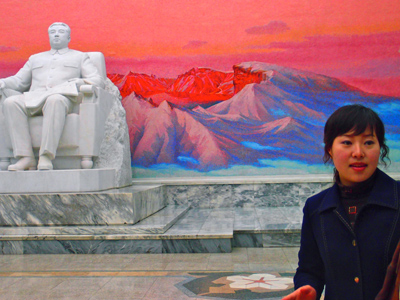
Lips and Lipstick, local guide, agricultural university, Wonsan

cynical PICKINGS from my NORTH KOREAN DIARY 11.–21. April 2011

Quite a lady

North Korean lips and Chinese lipstick, Kaesong City

Hairdresser at a cooperative farm, Wonsang

Local guide, Wonsan

Traveling through DPRK I come to the conclusion that, first, without Chinese help a revolt is impossible and, second, China does not lend it’s hand for an uprising. Mobility in DPRK is strictly controlled, districts, cities, villages, cooperatives are hermetically cut off, people have only shovels… indoctrination is very effective. After a disastrous currency devaluation, most people feel a lot poorer now. Hardship stifles protest.

My impression is that the Chinese don’t want to topple KIM JONG IL’S dictatorship for cynical and pragmatic reasons. They may fear that, without his ruthless grip on power, it could provoke a serious revolt and North Korea could rush inadvertently towards reunification with South Korea. A reunited Korea under Seoul leadership and allied to the US, highly developed, democratic and western oriented would make the “Chinese Teeth feel very cold“ indeed.

The Chinese tactic and strategy, it seems, is to keep the KIM’S in power, their paranoia alive and DPRK’s economy in endless decline.

They don’t want to get unpleasant things – like KIM JONG IL’S dictatorship – over and done with. In fact they detest a collapse of the system. They seem to prefer to draw out the agony: “Besser ein Schrecken ohne  Ende, als ein Ende mit Schrecken”.

The end will come but in endless and invisible small steps, unnoticeably. Then the Kim regime will come under Chinese patronage. They will help but at a price. North Korea will move into China’s orbit. China is already now buttering up the North Korean consumer – not South Korea and the West. They will keep the KIM JONG IL regime afloat and secure KIM JONG UN’S succession

Lips and Lipstick, local guide, cooperative farm, Wonsan area

The Chinese want to make sure that their North Korean lips will have Chinese make-up on. China, it seems, pays great attention that North Korean and Chinese economies will be close-knit. Beauty products are a forerunner of this strategy, the lipstick a symbol of it.

Public kiosk (not private) in Pyongyang, street vendor selling water at KIM IL SUNG'S 99th birthday – She was not allowed to sell me a glass of syrup, my “permanent" guide said NO.

For the Chinese leadership governments, dictatorships come and go. Their goal is to penetrate systems and political structures by means of production, exert influence and strengthen ties at all levels through market domination.

North Korea will become a satellite of China. This is not what the KIMS want. But there is no alternative to the regime survival of the KIM family.

Primatologist, our local guide at the showcase maternity hospital in Pyongyang

Guns, Lips and Lipstick, local guide, Pyongyang
Signs of Things to Come?

private enterprise PICKINGS from my NORTH KOREAN DIARY 11.–21. April 2011

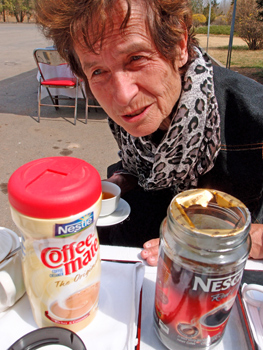
Nestle products

Having in mind that in November 2009, North Korea had devalued its old bank notes with virtually no advance notice by 100 to 1.  The old denomination of 1,000 won was replaced by the new 10 won. North Koreans were only allowed to exchange up to 100,000 won approximately US$25 to US$30 according to the then-market exchange rate of the old currency for the new bills. Many people saw their entire private savings wiped out overnight. North Korean Supreme Military Authority issued shoot-to-kill orders on the Chinese-DPRK border. Authorities were afraid of a massive exodus by middle class North Koreans with god.

I was looking for the old won and found prices in old won in Sariwon City at an ice cream seller.

Shell fishers refused to be photographed

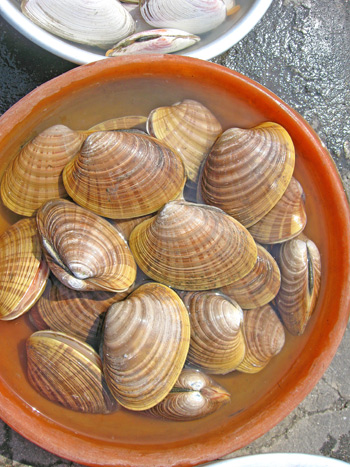
I was also keen to find signs of private enterprise in this classic stalinist regime of KIM JONG IL. At the beach in Wonsan I met shell fishers selling their catch in small portions.

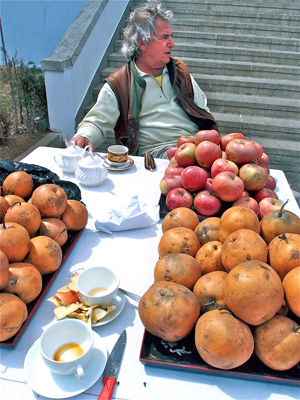
Apples from China

One day, traveling overland, our guides allowed us to make a toilet stop. We sat at the stairs of a closed down highway restaurant beside the road, bought a cup of tea, a brochure with the thoughts of “My Dear Leader“ and some apples (probably from China).

The dishes, tea and coffee they had brought in cardboard boxes. This stop was well organized and run by a group of women and men which must have had the support of the local bureaucrats (and our guides too) looking for Euros. It was the first and only time I saw Nestlé products in North Korea.

She was serving tea

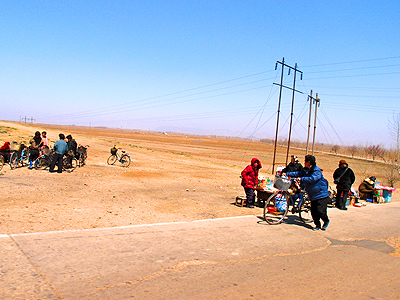
Private traders selling their goods - Is this a sign of things to come?

Private enterprise dies last or as we say in German “Die Hoffnung stirbt zuletzt”. Are these traces of things to come?

When I look at the girl – she was quite a lady – who served us tea and coffee with Coffee Mate from Nestlé, I think these are indeed hidden signs of change, of “Big-Brother-influence” creeping up on North Korea from over the border, “brotherly touches” not even “My Dear Leader” KIM JONG IL, the last Gate-Keeper of Stalinism, can avoid…

But most astonishing to me were the North Koreans who sold and traded their goods in a remote area on the South coast 30km outside of Wonsan. I was able to take a snapshot while driving by at 08:30 in the morning after we had stayed overnight at an old Soviet-type sanatorium (with cold Fango) outside Wonsan .

OVERLAND in DPRK

“superior“ PICKINGS from my NORTH KOREAN DIARY 11.–21. April 2011

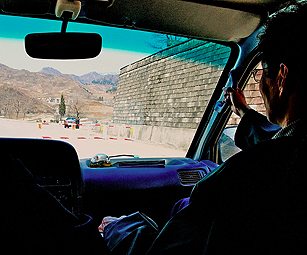
“entering DPRK” by rail from China was still very much on my mind when I pressed my movie camera to the car window trying to find a stable position for shooting. Traveling from Beijing to Pyongyang by train had made a lasting impression on me. But moving overland by car through DPRK was different. Though my guides wouldn’t allow our driver to stop or even to slow down when I asked for, I still got in closer in contact to land, buildings and people.
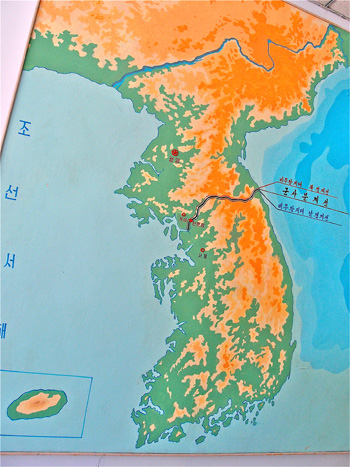
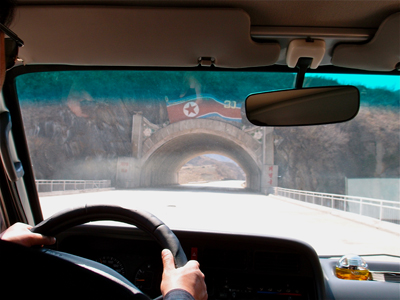
On the Panmunjom – Pyongyang highway I got the permission from my two guides to shoot through the window. This highway is the direct access road to South Korea.

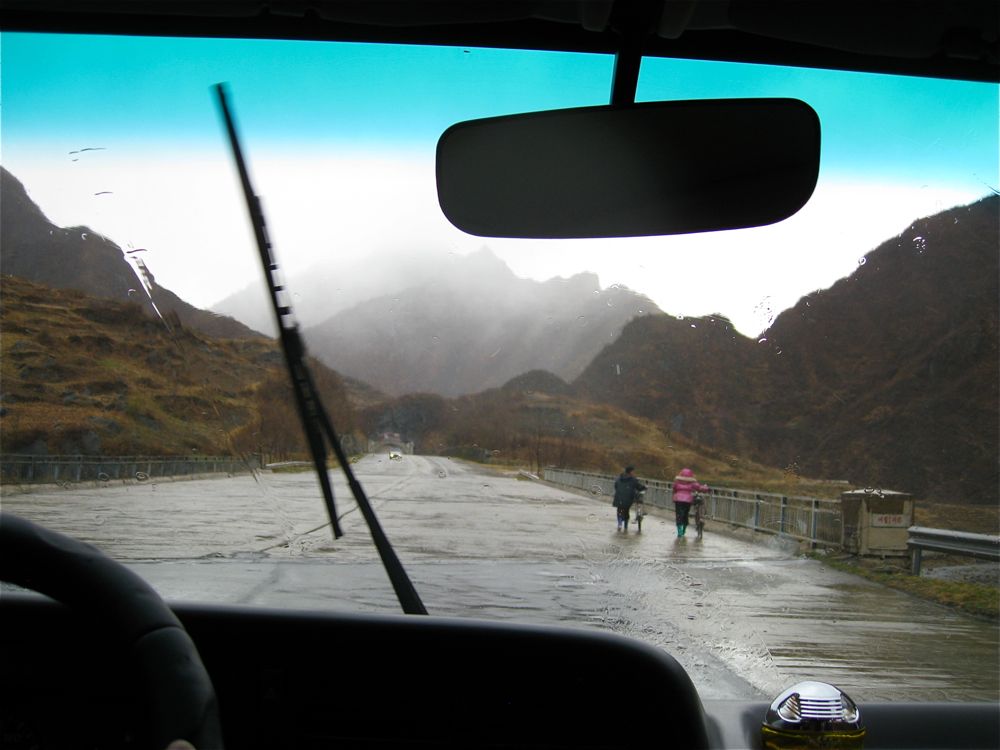
Like other highways we have passed, this one looked like an airstrip or a tank corridor too.

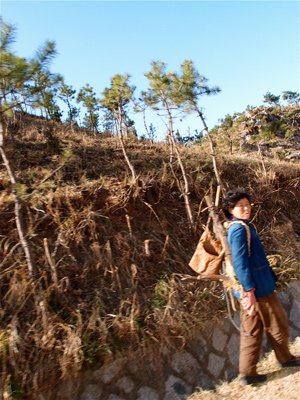
Fire wood - The man following on the side, the woman pulling...

Though the road was in poor condition, the car windows dirty and the circumstances very shaky, I was elated to get that chance. No cars were in sight. Sometimes people were walking on the highway.

Female farmworker

As it always happened day after day, the two guides discussed every move of us over lunch and talked daily to the main travel office in Pyongyang to get instruction.

tête-à-tête

After arrival in Pyongyang that evening, they must have discussed the filming with their superior because next day all shooting from the car window was forbidden…

more NO!…NO’s!… ways to look behind the curtain of DPRK

live PICKINGS from my NORTH KOREAN DIARY 11.–21. April 2011

...only a few running cars

Highways like frontline airstrips

Highway roadside traffic

The NO!…NO’S! of our two guides are an everyday occurrence. I don’t work with hidden movie or photo cameras, my shooting activity is open but my focus I keep obscured by not looking through the finder.

Shooting from the hip

Since the guides don’t allow stops on the highway or in cities without prior permission from the central travel office in Pyongyang I shoot from the hip.

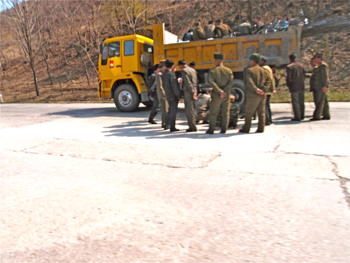
Army road block

I take photos or movie from all types of angles. My “luck“ is that roads and highways are often in poor condition and we roll by comfortably at 40-60 km, perfect to take snapshots.

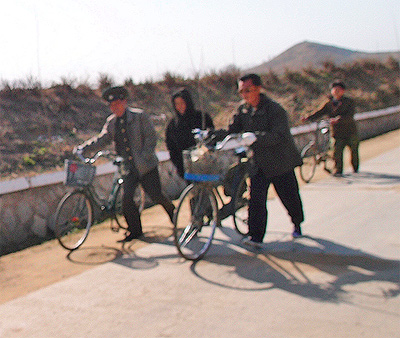
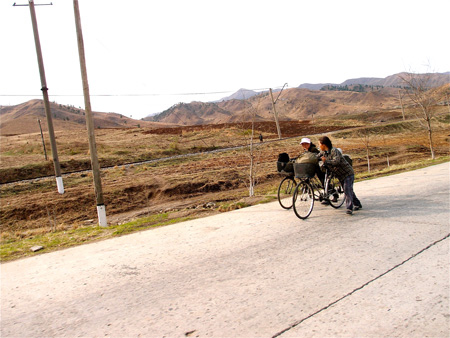
Highway bikers - much more common than cars

Just as regular as pedestrians and bikes are oxen carts on the highway.

Man and ox - regular highway traffic

Broken down trucks on the roadside I see sometimes more often than cars driving.

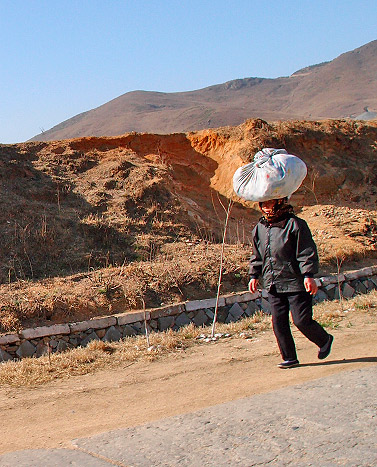
Head transport on the highway

Driving overland on the highway from Pyongyang to Wonsan on the East coast, a distance of about 200 km, I count 25 oncoming cars while on our side I see 11 vehicles in need of repair.
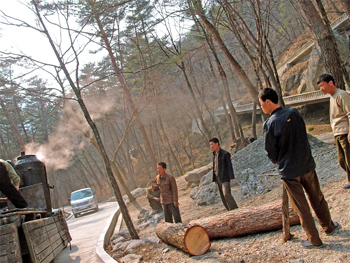
The most modern trucks I have seen in North Korea

A NO! NO! shot. North Korean soldiers wait for the blow-out to be fixed

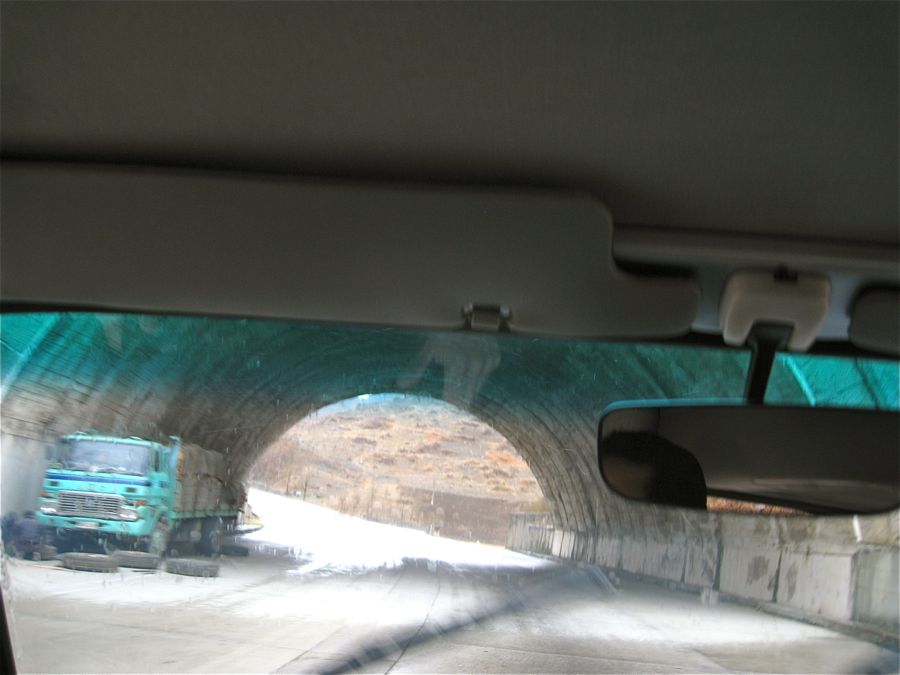
Hitch-hikers in the tunnels are a special experience.

Hitch-hikers are extremely rare

The NO!…NO’S! are an attempt to hide the harsh living conditions of the North Koreans and erase them from the travelers eye.

Crossing the railway tracks, our driver has to slow down... - In the background behind the biker people are walking on the tracks. This is very common specially in the morning and evening hours. Rail tracks offer the shortest link to the next destination. Trains ran not very often and when they approach the people on the tracks they honk early.

Our guides allowed the driver to make an unplanned stop only in a very remote area but even there Tung Hui followed me, stood in front of my camera to prevent me from taking pictures.

Woman transporting coal to the city

As a western tour operator, stationed in Beijing and in the North Korean tourist business for over 10 years, said to me: “We all know that the view KIM JONG IL’S dictatorship imposes on us does not reflect everyday life in DPRK.”

But there are ways…  …to look behind the curtain.

A moment to himself

Pushing uphill

Pulling wood along the highway

PANMUNJON – It is 70km to Seoul

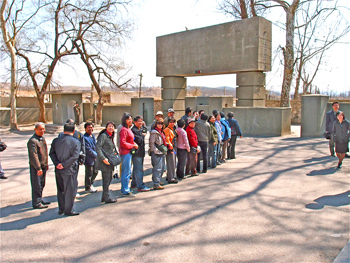
Panmunjon - Tomb of lost hope - View to the South Korean side

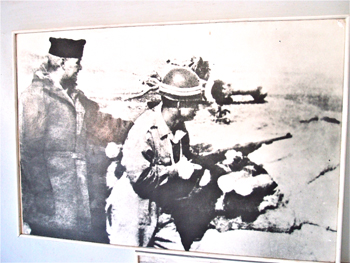
North Korean war photo from the Armistice Talks Hall at the DMZ

North Korean propaganda officer “welcomes“ Ursula at KPA post

CHEJU-honeymoon-dream PICKINGS from my NORTH KOREAN DIARY 11.–21. April 2011

The wishful thinking of reunification obscures the fact that North and South Korea are light-years apart. Social and economic realities of the two Koreas’ are differently cycle-controlled. But both seem to have adopted the rule: If reunification is not working, stick to it anyhow!

We join a group of Chinese tourists - In the background the entrance to the Demilitarized Zone DMZ

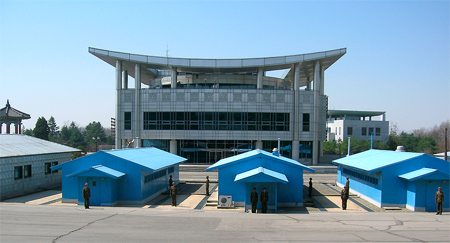
Arriving at the KPA post just outside the DMZ we join a group of Chinese tourists. We were picked up by a soldier in his thirties – in charge of propaganda – who took us to the Armistice Talks Hall where negotiations were held from 1951 till the signing of the final ceasefire accord on 27 July 1953.

At the Armistice Talks Hall we got a lecture on the Korean war. The Chinese group applauded and agreed with the remarks of our North Korean soldier.

The Korean nation is divided along the 38th parallel into North and South Korea

As we had experienced before, Chinese tourists had more leeway and could move more freely which rubbed off on us two. Whatever the Chinese were allowed to do at the 38th parallel we could do also: we got more photo opportunities, were allowed to visit to the toilet in the official border building finding out that the toilets didn’t work because of electricity shortage.

I asked the North Korean army man when he would like to marry. He said “after reunification, maybe next year“. He thought it would not take longer than 2 to 3 years at the most. He would then go on honeymoon to the famous Cheju island in the South Korean sea.

North Koreans’ believe that KIM IL SUNG liberated them and that South Korea is still occupied by the US army up to now.

Ursula in front of the North Korean version of the final armistice treaty which was signed on 27 July 1953. The text goes like this: “On July 27 1953, the American imperialists got down on their knees in front of the heroic North Korean people and signed here the ceasefire for the war they had provoked.“

To them, the Americans were – and still are – the aggressor who started the war but finally had to succumb to the North Korean forces. Of the two Koreas’ they believe, it is them who live in a free and democratic state since 1953.

The countryside at the 38th parallel

The eerily soundless environment oft he DMZ was only interrupted by our lively Chinese tourist group.

North Korean propaganda officer elaborates on Panmunjon DMZ with an illustration that totally belittles the death-zone and the extremely heavy fortified border strip which makes escaping impossible

It’s a unique experience to see things from a North Korean perspective. The population is hermetically cut of from all outside influence and can not imagine how different the world is outside of North Korea. In their opinion it is just a matter of time until the American aggressor is defeated and the capitalist system of South Korea collapses. It’s like somebody kicking the can down the road but the can is getting heavier, the distortions more difficult to hide. The danger of a total collapse of the systems shows itself in the military posturing and in the harsh Gulag style atmosphere within DPRK.

learn from BIG BROTHER

chinese PICKINGS from my NORTH KOREAN DIARY 11.–21. April 2011

It pays off to walk behind a Chinese. This invaluable lesson I learned in DPRK. Chinese in groups are a friendly bunch, they laugh, are loud, say hello and often ask to make a photo with you. They care less about restrictions, take pictures we are told not to make and walk around more freely. Moving behind a Chinese or a Chinese group of travelers is like moving your boat behind an icebreaker in the Arctic Zone. Chinese seem to be “naturally“ hearing impaired, easy-going and not responsive to every whim of their guides.

I quickly understood that if I wanted to make contact with local North Koreans I had to hang behind my guides at least 20m – and behave like a Chinese.

a Step FORWARD – this time it might be different

key-PICKINGS from my NORTH KOREAN DIARY 11.–21. April 2011

Coming by train from Beijing on April 10, having experienced the enormous building boom, industrial development, highway building and the extension of the superspeed train right up to the DPRK border town, my guess was that “Big Brother“ would tell the last Stalinist dictatorship of “My Dear Leader” KIM YONG IL, that time had come. When I sat foot in the DPRK, I was under the impression that only China had the key to the future of the Democratic People’s Republic of Korea. And so it was a reinforcement of my thinking how things would develop when Lukas, my son in law, sent me from Shanghai CHINA DAILY’s article on

Foreign and Military Affairs

China, DPRK to develop two economic zones

North Korea is indeed FRAGILE

Loggers loading stems on carburator truck

“deja vu“ PICKINGS from my NORTH KOREAN DIARY 11.–21. April 2011

Childhood memories appear from behind the couch. Korea takes me back to the 1950s. While for me it evokes nostalgic feelings, for North Koreans it represents decades of retardation ending in horrific poverty of today. To them it is a real tragedy.

The military has wooden carburator trucks too

It was in the spring of 1950 – I spent so many months of my childhood in the hills of South Germany that I became almost a native, speaking the local dialect – I was kneeling beside Franz who was fixing the wooden carburator of his tractor at the farmhouse, waiting to go to the forest with him and his brother Hans… .

Sixty-one years later in April 2011, hiking in the woods of Mt Myohyang 150 km

Loggers in Mt Myohyang
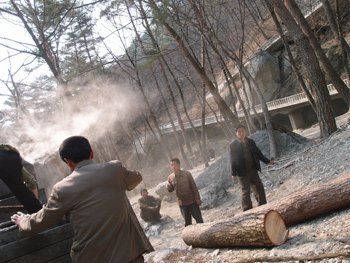
north of Pyongyang, I was taking photos of “deja vu“, six forest workers, uploading stems when back in 1950, there were two men who did the job and an infant watching… .
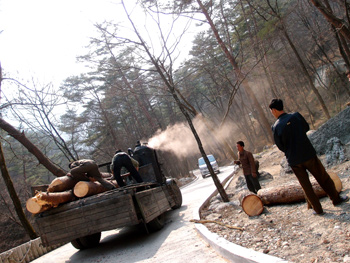
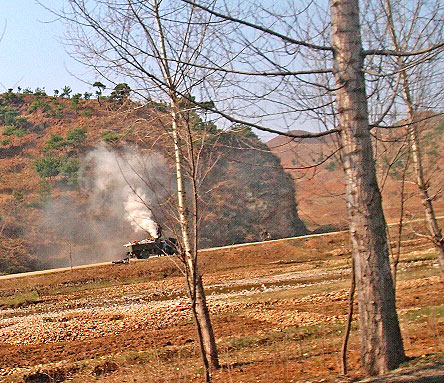
I came across many wood carburators on the highways we traveled, giving weight to my observation that North Korea suffers a severe transportation problem and energy shortage. The “Holzvergaser“ trucks

A mysterious fragrance contrasted by a dreadful reality

dating to the 1950s and 1960s of the former USSR often broke down on the highway.

I did not see gas stations in the cities nor on the highways. When our driver got gasoline, he dropped us together with one guide on the roadside and left for 15 minutes to fill up his tank. We were not allowed to be present at government gas stations, neither in Pyongyang nor in any other city.

“Holzvergaser“ truck on a side road we have no access

Gasoline shortage was clearly evident where ever we traveled on the East and West Coast. Transportation means for the lower level of the population are in a precarious state, 1950s UDSSR-made vehicles.

Wooden carburator, military truck

The SNAKE in the GRASS

tricky PICKINGS from my NORTH KOREAN DIARY 11.–21. April 2011

KIM IL SUNG at the Grand People's Study House

It’s NOT a lie! No, I don’t say they lie at me. It is a different frame of mind, sometimes it is an anxious state of mind that dictates them and their actions, other times it looks like utter confusion or just paranoia in hiding.

It is the dictum of “The Eternal President“ KIM IL SUNG – the only statesman on earth who remains President even  after his death in 1994 that is of utmost importance.

KIM IL SUNG at the Grand People's Study House

KIM IL SUNG – The Eternal President

He and his son KIM JONG IL, called “My Dear Leader“, are telling Right from Wrong, Good from Bad. They decide what is real and what has to be banned, who is sent to the university or to the work camp, to the labor camp or to the gulag. KIM IL SUNG and KIM JONG IL have a six-decade grip on power.

KIM IL SUNG with local guide in the entrance of the Grand People's Study House

All in the Family - KIM IL SUNG “The Eternal President" and his son KIM YONG IL, called “My Dear Leader"

Our two “permanent“ guides work under the spell of this government-mind-set, they tell me that the local shops are closed when they are open, that people don’t like to make contact with a foreigner when in fact they wish just that. They change our itinerary every day but if we want to make an additional stop, it’s impossible.

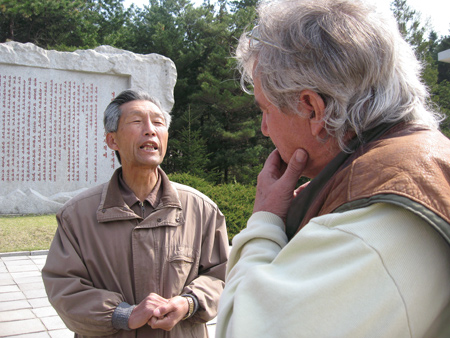
This gentle local guide liked my questions, Agricultural University, Wonsan area

They make me feel like a disobedient child who doesn’t quite get it when I keep asking questions or like a snake in the grass when I make photos of simple life events.

Fear is guiding the system. The world of DPRK is under a delusion.

The hinge joint is the personality cult.

My guess is that “Big Brother“ will tell them. China holds the key to the future of the Democratic People’s Republic of Korea.

BREAKFAST at a SOVIET SANATORIUM

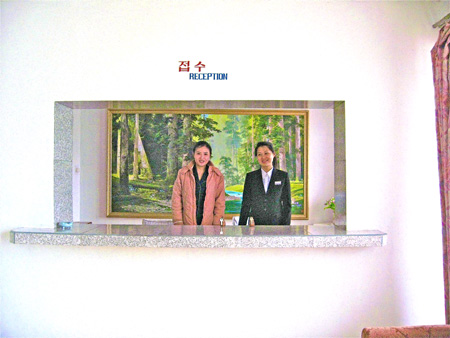
Our local guide and receptionist at a formerly Soviet spa

FANGO-PICKINGS from my NORTH KOREAN DIARY 11.–21. April 2011

At lovely lake Si Jung, the sanatorium is tucked away...

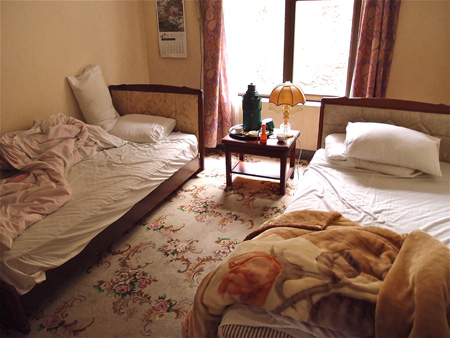
We are located in a old Soviet-type sanatorium at lake Si Jung outside Wonsan which was built  in the early 1960s, when North Korea grew rapidly. During that time a chain of resorts were built all over the Soviet Empire for the Communist Partys’ leading members to visit and consult each other, relax and go hunting.

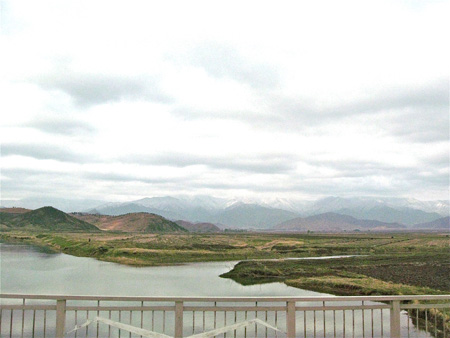
Built on an artificial lake, the sanatorium is tucked away behind the road but close enough to the sea with a view to the mountains we had just passed. It offered privacy to the communist party members of the Soviet Empire from Georgia to Kazakhstan, from Moscow to Kyrgyzstan. Tourists nowadays pay for their upkeep (since almost no communist party boss is left over “from the good old times“ and those from China and North Korea most likely prefer more comfort.).

From "Russia" to "Kyrgyzstan."

From the "Georgia" to "KAZAKHSTAN"

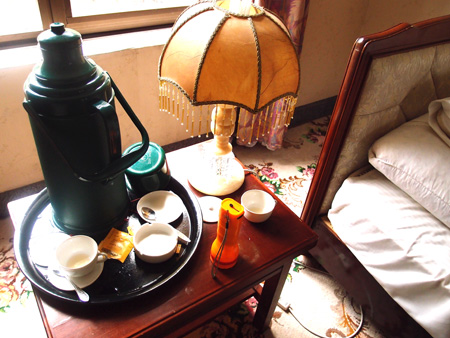
We stay at this famous spa with electricity for 3 hours in the evening, almost no running water and a special fango-pack  treatment that was cold because of a power cut.

We are the only guests and retire early to do some talking and writing. Unexpectedly at 10pm, the light goes off and we sit in the dark not quite remembering where the toilet was… .

From nowhere we jump awake at 5am next morning realising that we forgot to switch off the light… . Suddenly the electricity was back on… .

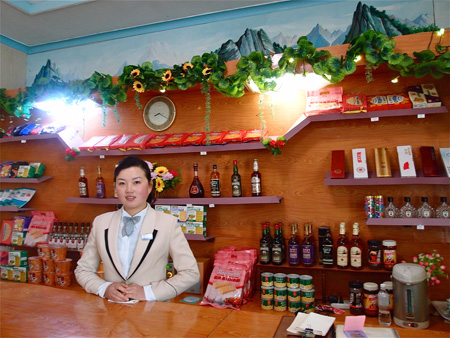
Waitress at the bar

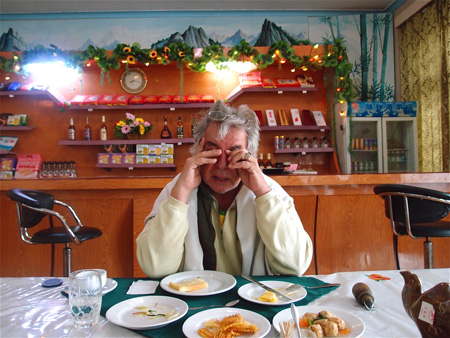
Breakfast is at 8am. We are very well received by our waitress behind the bar which serves us a full meal under a big painting of a mountain scene close to the Chinese-North Korean border.

Oh! KIM IL SUNG!!... Oh! KIM JONG IL!!... Oh! Communist Party!