SOUR PICKINGS from my NORTH KOREAN DIARY 11.–21. April 2011
FAR MORE I resented the political system of the KIMS for having effectively established a paranoid, all encompassing power structure with the purpose to dehumanise contact and treat emotional exchange and empathy as forbidden acts. This state of mind obliged our guides to twist contact making and enforce restrictions on us.
Toilets were solemn places...
Whenever this got to me and threatened my well-being and my mood turned dark, I asked for the toilet.
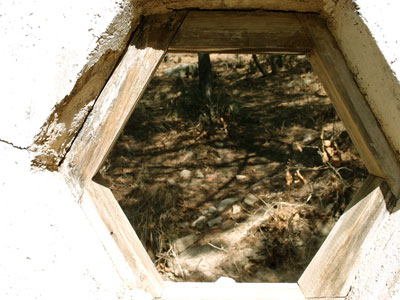
Toilet at Mount Kuhol...space to myself...
Not so much because I wanted to vomit but for the sake of having space to myself. Though the stench often was unbearable the reality of the system was far worse.
...the reality outside was far worse...
Under circumstances like these toilets were solemn places and offered a rest for my agitated and angry mind in turmoil.
BLOSSOM-PICKINGS from my NORTH KOREAN DIARY 11. – 21. April 2011
WHEREVER we move, the system tries to infect relations with the virus of distrust. Our two guides, who have the job to separate us from any spontaneous contact with people, are especially under pressure in the capital Pyongyang where the state travel agency is located and they feel under observation.
DPRK army soldiers pose with Ursula for a fellow army soldier
But people are not molecules. Whenever I manage to have more than 15 to 20 meters between me and our two guides I manage to establish spoken contact. Three girls on a park bench giggle when I pass by. “How do you do?“ they ask me and we exchange a few words till the guide is back on my side. I make this experience many times, a laugh, an eye contact…curiosity never dies.
Three children want a photo with Ursula
Two female soldiers take Ursula in their midst
KIMILSUNGIA – Flower of Reverence. In 1965, President Sukarno of Indonesia offered this Orchid to President Kim Il Sung as a present and proposed the name "KIMILSUNGIA".
At the National Flower Exhibition for the 99th birthday of KIM IL SUNG, The Eternal President, emotional contacts are flooding us. Control and separation tactics don’t work any more and we mix freely with children, couples, military personnel. We make photos and they ask us to make photos with them: soldiers, children, couples.
Ursula with Chinese student studying North Korean for 9 months in the capital Pyongyang
“Our North Korean teachers are very strict with us“
They look like from a different star...
We also meet a group of Chinese students, they study Korean at the local university for 9 months. They look like a bunch of extraterrestrials from a different star: well dressed, laughing and joking, talking to us as if we were sisters and brothers, taking us into their midst. My questions: “And how is life in Pyongyang?“ they answer with: “Living conditions are very poor.“ I follow up with: „How are your teachers?“ Their mood darkens: “They are very hard on us, the professors are very strict.“ (Imagine what it takes till a Chinese student complains about “discipline“ after all the exams she or he had to pass in his hometown to get selected by the Chinese government for studying abroad).
The Chinese student said: "Living conditions at the University in Pyongyang are very poor"
RICH PICKINGS from my NORTH KOREAN DIARY 11.-21. April 2011
WE VISIT the PALACE of the CHILDREN called MANGYONGDAE. Everywhere we go, a local guide is waiting for us. This time it is a 13 year old schoolgirl who is leading us through the Palace of the Children, stretching over 300’000 square meters of marble on six floors.
We start with the:I want to stay longer and enjoy the “Lightness of Being Young“ so beautifully performed with the greatest ease. But we move to:
The piano practice studio is next with 10 pianos being played by girls and boys at the same time with works from different composers – it sounds like cat-cries in the dead of night – but if you listen and watch carefully each child is playing exactly his own piece, the discipline is amazing:
Then we enter the DRAWING ROOM and I experience a flash: 52! years back I was sitting on my desk in the drawing room at the “Humanistische Gymnasium” nervously chewing on my pencil because the perspective of my flower-still-life was false… .
In a cloud of dust old memories appear… The drawing experience at the “Children’s Palace“ in Pyongyang, North Korea, is truly refreshing.
Back in 1953, my desk neighbour in primary school was a big accordion talent. I tried it too, took two classes but had no talent. Though it was half a century later, visiting an accordion class in North Korea at the other end of the Eurasian continent feels like back home in the Palace of my Childhood.
The DRAMA VOICES give me an uneasy chill-down-the-spine feeling like high winds blowing over mountain ranges make me feel to be in haunted places. This traditional female voice training contains an eerie mastery of timeless female suffering passion.
The CONCERT ZITHER, a plucked musical instrument of folk music origin is next. As I work my camera into what begins to look like an orchestra of spyderwebs, I get fascinated by the fingers dance and how the are stringing beads of sound.
The GIRL’S CHOIR is practising a full anthem with reference to the Eternal President Kim Il Sung.
TRADITIONAL DANCE is the last class we visit at the Children’s Palace in Pyongyang.
Amazing flute player
Then we listened to the amazing wooden flute player accompanied by 12 mandolines. Leaving the practise area, we were led to the orchestra hall for a performance of all studios: a seven year old boy played the drums like a whirling dervish…
At the end of the show in the orchestra hall the girl who was guiding us is waiting at the aisle. She takes Ursula’s arm into hers and walks with her to the exit. She doesn’t let go even as her teacher, waiting outside, is giving her clear signs she should return. The girl says “no“ she wants to bring Ursula to the car. There she hugs her several times and shakes hands with us. As we are driving away, she stays glued to the ground waiving, she stays put, waves with both hands, she doesn’t move. Tears don’t come easily to me, but here in Pyongyang, the Capital of North Korea, under circumstances hard to describe, I’m deeply moved.
THE TRAIN is moving at a leisurely pace through the hills and fields, crossing large riverbeds, some carry only a trickle of water.
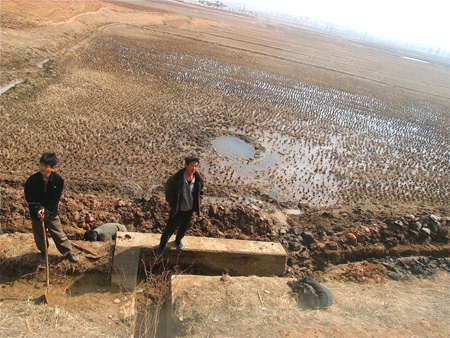
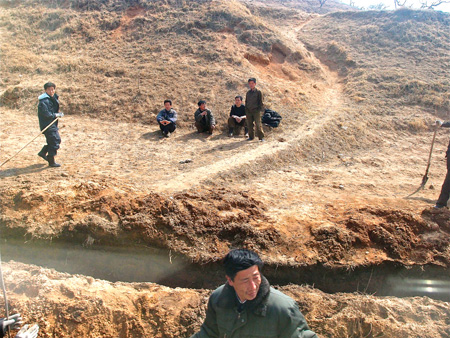
...passing by - men with shovels...
Repairing the trenches
View from my sleeper bed
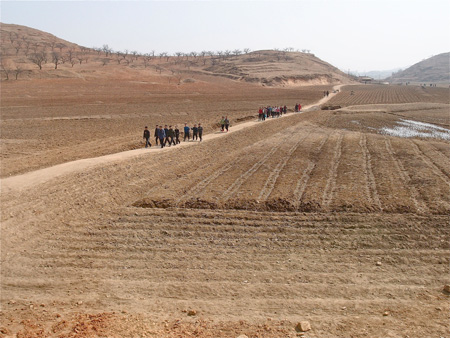
Workers head to the field
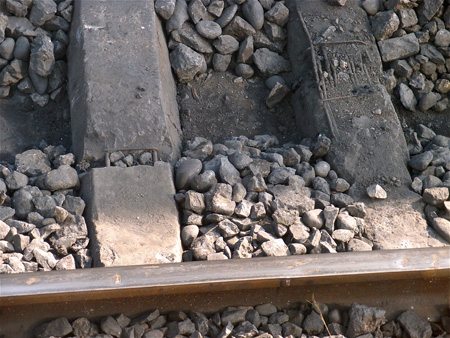
The railway track-sills need repair, some are broken.
We travel at 30-50km/h
We head to the restaurant wagon over luggage and people in the gangway.
Goods for Pyongyang
...sleeping...
Passengers are playing, eating, talking, sleeping.
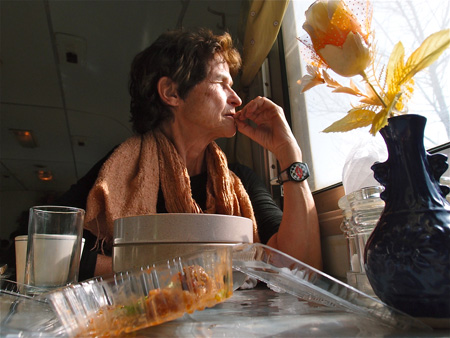
Dining car – we are in good company
The supper we had ordered is ready and we mix with the Chinese who bring their goods to Pyongyang. It takes us 26 hours to travel from Beijing to Pyongyang at a speed of 30-50km. The heart and mind has time to adjust – from China to North Korea we travel back in time. Sometimes it looks like the Middle Ages but more often the horrible Stalin area comes to my mind.
prime PICKINGS from my NORTH KOREAN DIARY 11.–21. April 2011
Tool of the land
A bucolic touch...
As THE TRAIN pulled out of the Korean border station two hours late – the customs inspection had taken over four hours all in all – it suddenly became clear to me that we were on our way to a KAFKAESQUE land with aspects of BRUEGHEL and a BUCOLIC touch.
...as far as the eye could see...
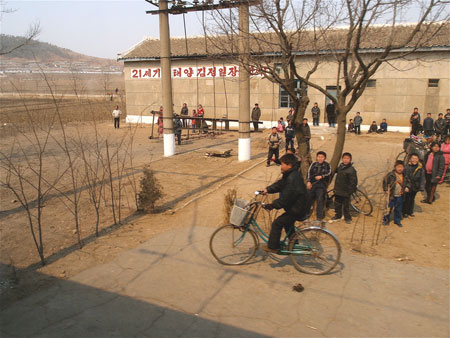
As far as the eye could see: groups of farm workers, schoolchildren moving by foot to the fields, a few on bicycles, detachments of soldiers with shovels, some on military trucks, farm workers with ox carts, men ploughing the field.
men – women – soldiers – children
Men and women of all ages hacking and working in the water channels and the rice fields with almost no mechanized help beside an old tractor here and there, cows pulling the plows, the rest all handwork. Cooperatives and villages dotted the land.
A Cooperative Farm in the background
Farm workers
But the BRUEGHEL and BUCOLIC touch soon gave way to the harsh reality of a hermetically sealed of population with no exit out of the cooperatives, the villages, the cities, the country without official permission. If the desperate and the hungry flee over the border to China, Big Brother shows no pity. He sends them back to North Korea where they end up in labor camps or are shot dead as it had happened during the horrible flooding catastrophe in 1974 when 3 million people died and starvation followed.
DEPARTURE PICKINGS from my NORTH KOREAN DIARY 11.–21. April 2011
Chinese dining car – from Beijing to the border of North Korea
China is booming right up to the border of North Korea
WAGON NR. 12. Yes we finally are entering the wagon Nr.12, we have compartment 3. Our Chinese guide never had done it before, he brought us first to the wrong Nr.12, the railcar destined to go only to the border town Dongan The railcars bound to the border were full to the ceiling with luggage and people, no space for sleeping. So we were happily surprised to find another railcar Nr.12 at the very end of the train, more than half empty with a compartment for four, ready and awaiting just us two. There were three other guys from Berlin and a group from North America. Nobody else.
A maximum of comfort
One could feel the isolation of North Korea already by way of how the train was composed: twelve railcars packed with locals and their belongings and separated two railcars bound for Pyongyang with just a handful of travelers. It felt like traveling to the end of the world…
How wrong I was! Stopping every three hours at another city, I was in a daze.
How wrong I was!
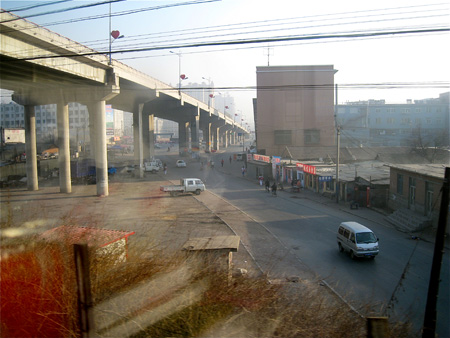
It felt like moving from boom town to boom town, new cities were being built, I counted hundreds of skyscrapers at each stop, cranes everywhere as if Beijing had never stopped! But not only housing but also factories, shopping malls, roads, new highways, brand new railway stations and last but not least pillars like beansprouts for the Chinese-made super speed train, based on Siemens technology. My eyes glued to the window, I entered a totally new world spanning from Beijing right to the border of North Korea.
What in my imagination had been a no-mansland is actually most electrifying: modern transportation facilities and city building hit the North Korean border with a vengeance.
Brand new Chinese railway station at the border to DPRK
What would this do to North Korea in the not too distant future? What meaning did it carry for the hermetically sealed North Korea, how would this affect THE ONLY PARADISE LEFT ON EARTH as the communist PR-machine is praising North Korea? Is an uprising possible in the family dictatorship of the KIM’S?
“CHINESE” PICKINGS from my NORTH KOREAN DIARY 11.–21. April 2011
"HAPPY LIPS"
ON OUR WAY to the railwaystation in Beijing, Ursula asks our chinese friend: „What means North Korea for China?“ He smiles: „China is like Big Brother to North Korea. Big Brother can criticise small brother but foreigner can not. Then he continues: „China braucht Nordkorea.“ I ask: „How come?“ He smiles: „There is a saying in China: Ohne Lippen haben die Zähne kalt.
“DPRK is a Knautschzone for Big Brother China?” He chuckels. “The same is true for Tibet? China needs “Knautschzonen“? He smiles. I continue: “China has many lips? North Korea, Tibet, Nepal…maybe Taiwan? China has many sets of teeth?” He smiles again. “China has many tongues…?”












Commentos